
Adding More Won't Necessarily Grow Your Business
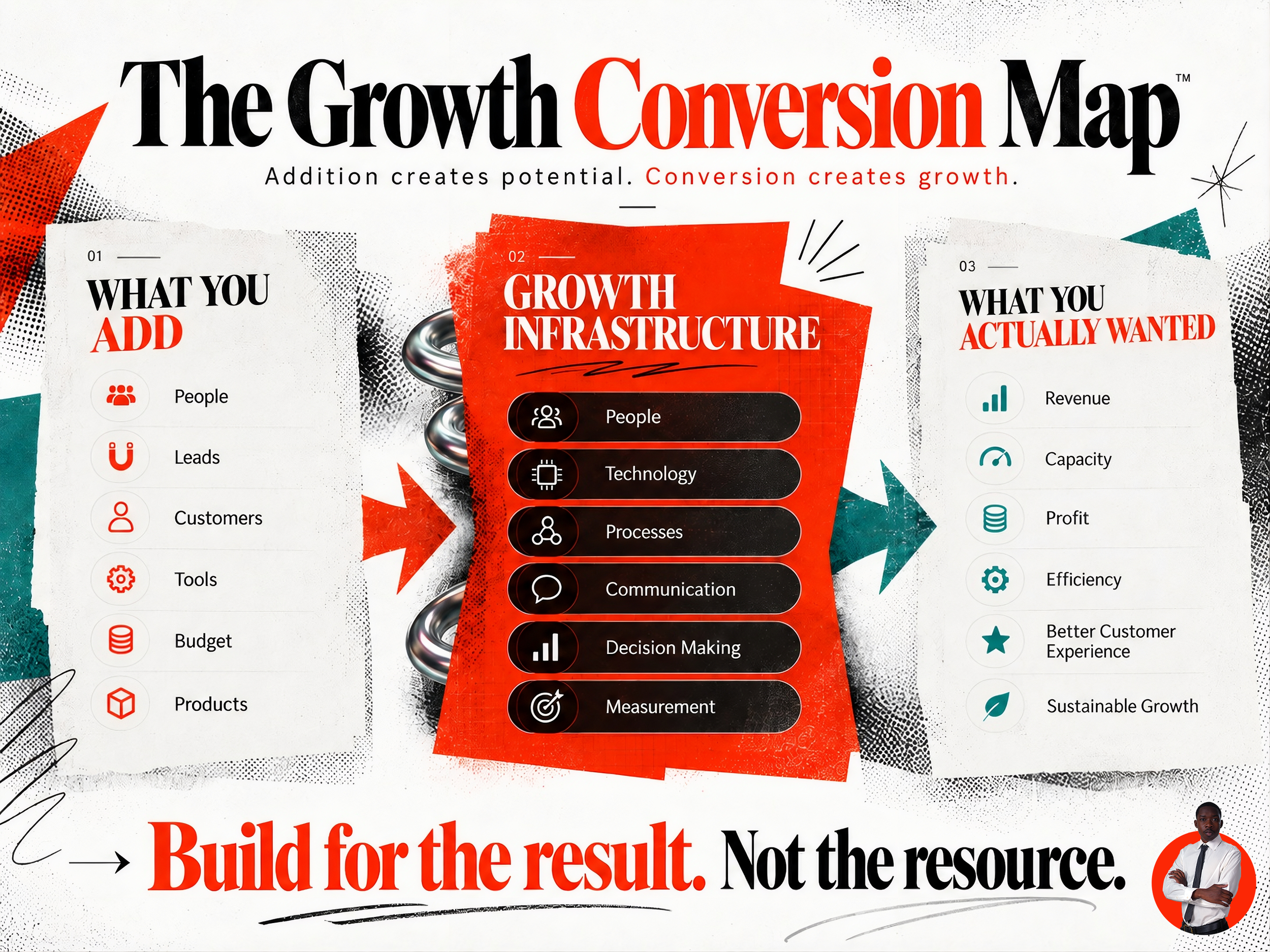
There is a point in almost every growing business where “more” starts to feel like the obvious answer. More customers. More leads. More ad spend. More employees. Maybe another SAAS service. Or how about another software subscription they swear is going to be the key that changes everything?
It makes sense. When something is working, we naturally want more of it. And when something is not working, we often assume we need more resources to fix it.
That's why when the team is overwhelmed, we think we need to add another person.
Eventually, “more” starts to become almost interchangeable with “growth”
But when founders tell me they want to grow their business, I have found that “growth” can mean almost anything. Sometimes they mean more revenue. Sometimes they mean more customers… a larger team… a new product line… a bigger audience… And sometimes, if we are being real, they just want the business to feel like it is moving forward.
None of those goals are necessarily wrong. Sometimes if sales are flat you literally just need more leads. The problem is that adding something to a business and growing the business are not automatically the same thing.
Adding more gives the business more to work with. What happens next determines whether it actually becomes growth.
Addition Creates Potential. Conversion Creates Growth
This is where I think we have to separate the act of adding something to a business from the act of actually growing it. Adding a resource can create new opportunity or new potential, but those things are not outcomes on their own. A business still has to be able to convert what it added into the result it was hoping to create.
That distinction matters because growth is often discussed as though the adding something in itself is the milestone. We hired someone. We increased the budget. We added another service. We generated more interest. Those things can all be useful signs that a business is moving, but they really mean nothing if you are targeting growth.
The more important question is “what changed because of the addition?”. Did the business become more profitable? Did it create more capacity where capacity was actually needed? Did the customer experience improve? Did the company become better positioned to reach the next goal?
This also means the intended result has to be clear before the resource is added. (BEFORE!!!) Otherwise, it becomes very easy to decide after the fact that something worked simply because it was useful. And usefulness absolutely has value. But relief, efficiency, stability, and growth are different outcomes, and they should not automatically be treated as interchangeable.
For me, this is where a lot of growth decisions become less about asking, “What should we add?” and more about asking, “What are we trying to change?” Once that answer is clear, the business can start thinking about whether the thing it wants to add is actually capable of producing that change, and what will need to exist around it for that to happen.
Spoiler Alert: Sometimes the answer is actually not adding more (I mean, it is in the title)
A Tales of Two Companies
Let’s bring this into the real world. Consider these two companies.
Company A decides it is time to add a new employee. The goal is growth. This person is supposed to help support a new revenue stream and help the company move into services it has not been able to fully pursue with its current team.
The hire is made, and the employee turns out to be great. She is helpful, capable, and quickly becomes someone the rest of the team can rely on. The problem is that the existing business is already stretched. There are customers who need help, administrative work that needs to be done, and people who are already overloaded. So little by little, the new employee starts getting pulled into whatever needs attention that day.
A few months later, everyone agrees that hiring her was a good decision. The office is running better. The founder has more support. The team has someone else they can count on.
There is just one problem.
The new service initiative she was hired to support has barely moved. In fact the company has barely onboarded any new customers.
Now consider Company B.
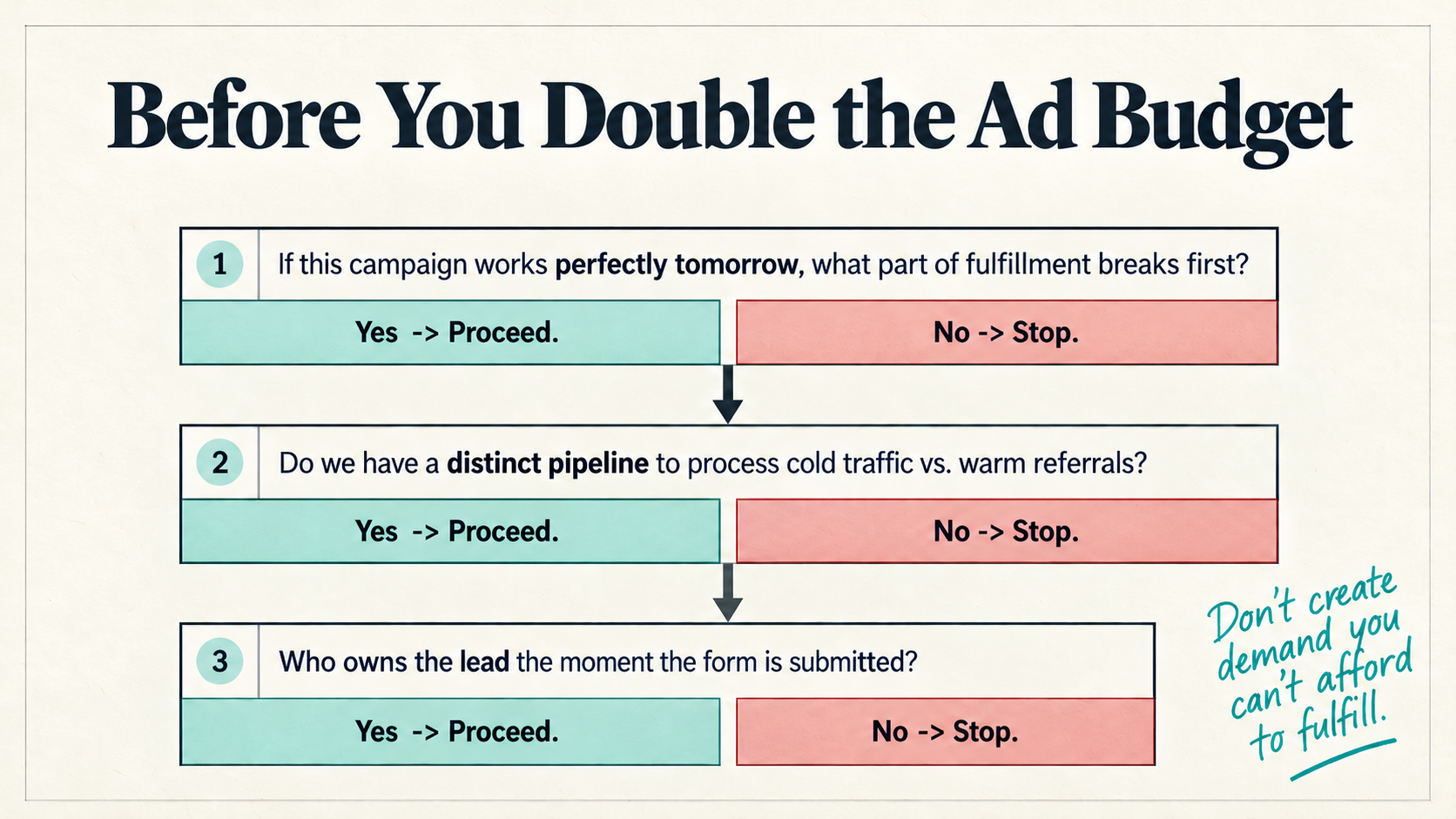
Company B decides it needs more sales, so it invests in a campaign to generate new leads. The campaign works and more people start filling out forms and leaving their information. On paper, this looks like exactly what the company wanted.
However in the past the business has mostly grown through referrals, where prospects already understand the company and arrive with some level of trust. These new leads are different. They need faster follow up. They create new emails when forms are submitted the company has never dealt with before. They need a consultation or demo before they become clients. They need new ways to be sent forms and pay differently. Some may need several conversations before they make a decision.
The company never built a process ANY for that.
So what happens is nobody clearly owns the new leads. Follow up happens when someone has time. Calendars are already full. And the company usually ends up trying to close the leads that are the easiest, not the ones that are most valuable.
Company A added capacity. Company B added more opportunity. In both cases, the business successfully got more of what it thought it needed.
What it did not have was everything required to turn that “more” into the result it originally wanted.Neither problem was caused by a bad employee or a bad marketing campaign. The additions even kinda worked.
The businesses just were not prepared for what needed to happen next. They didnt have any systems in place to turn potential into results.
No structure, no system, no direction, no aura (as the kids say)
Growth Creates Chaos Before it Creates Value
When we look at why both companies failed to reach their growth targets, we can trace it back to the one thing founders usually hate and try to skip over: before you can go forward, sometimes you have to go backwards.
Growth creates load. And that means before you ever reach the exciting target, there is usually a layer of work that feels unrelated to growth or, even worse, boring. When this layer is skipped we end up like Companies A and B.
You want more leads? Great. You may need to write sales scripts first. (Booo)
You may need to train the staff. (Boring)
You may need to take some time to rework internal workflows and write a few SOPs. (Yuck)
You may need to pay someone to build new email automations. (There goes the budget)
You might even have to rewrite a job description because the person who is supposed to handle all these new opportunities was technically hired to do something completely different. (Congratulations, you are in HR now)
None of those things feel like growth. They feel like preparation. That is exactly why they are so easy to put off.
But every new resource creates new demands before it creates its full value. A new employee from Company A needs direction, access, training, communication, and management before they can operate at full capacity. The increased leads from Company B require faster follow up, a clear sales process, available calendars, and someone who actually owns what happens after the form is submitted.
Hopefully you now begin to see that simply adding more did not fix the problem. Giving structure for the additional resources to flourish was the switch.
This does not mean a business has to become perfectly organized before it is allowed to grow. Oh no, I'm not saying that at all. You cannot predict every bottleneck before you encounter it, and sometimes you can absolutely build the plane as you fly it.
What should exist is enough structure to handle the additional load when it arrives. Someone needs to know who owns the problem, how it will be tracked, who has the authority to make a decision, and how the rest of the business keeps moving while it gets solved.
That is the less glamorous side of growth. Before the business gets to enjoy more, it usually has to become capable of carrying more. That means more work, time, and usually money.
When the Marketing Problem Isn’t Marketing

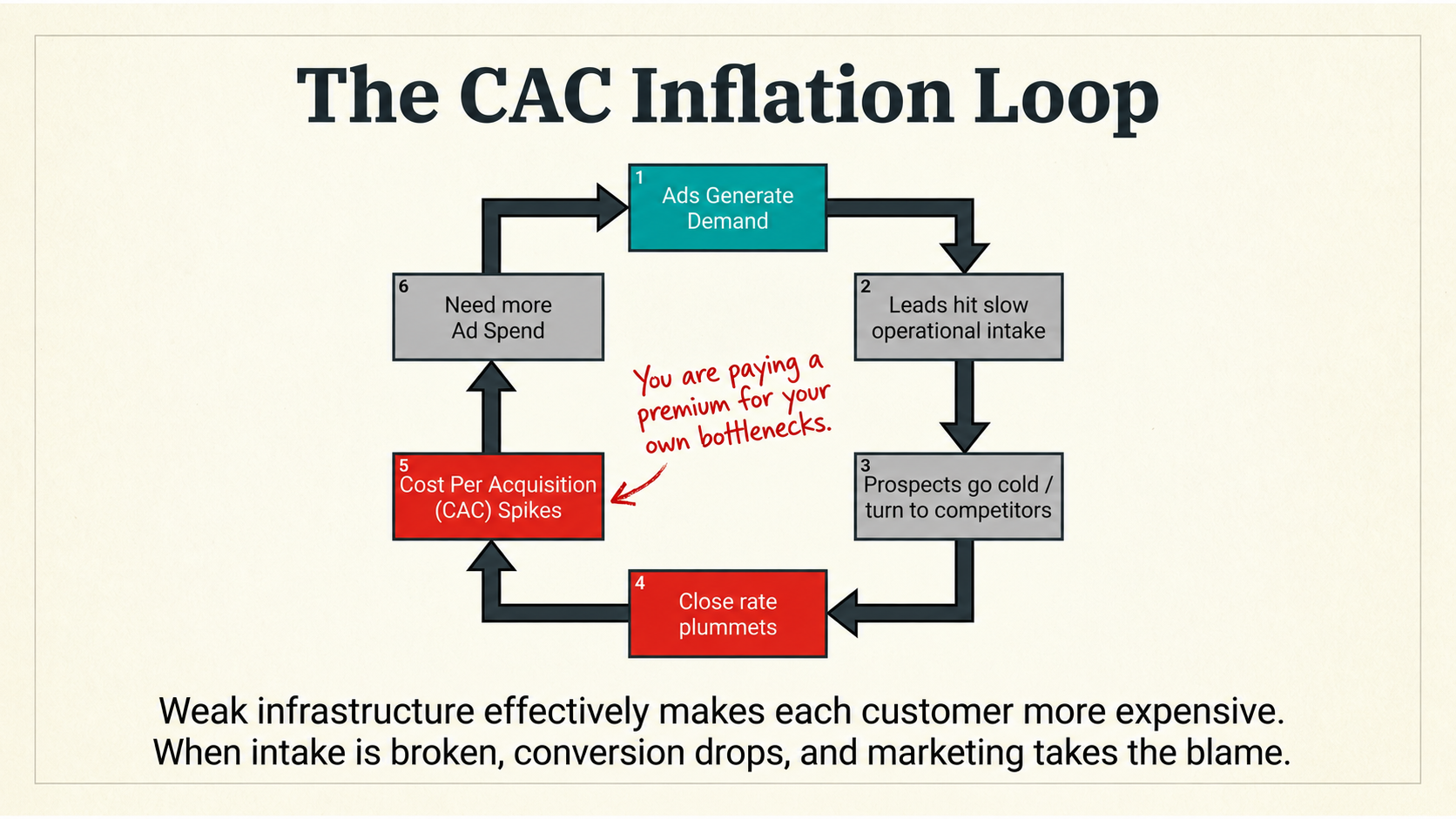
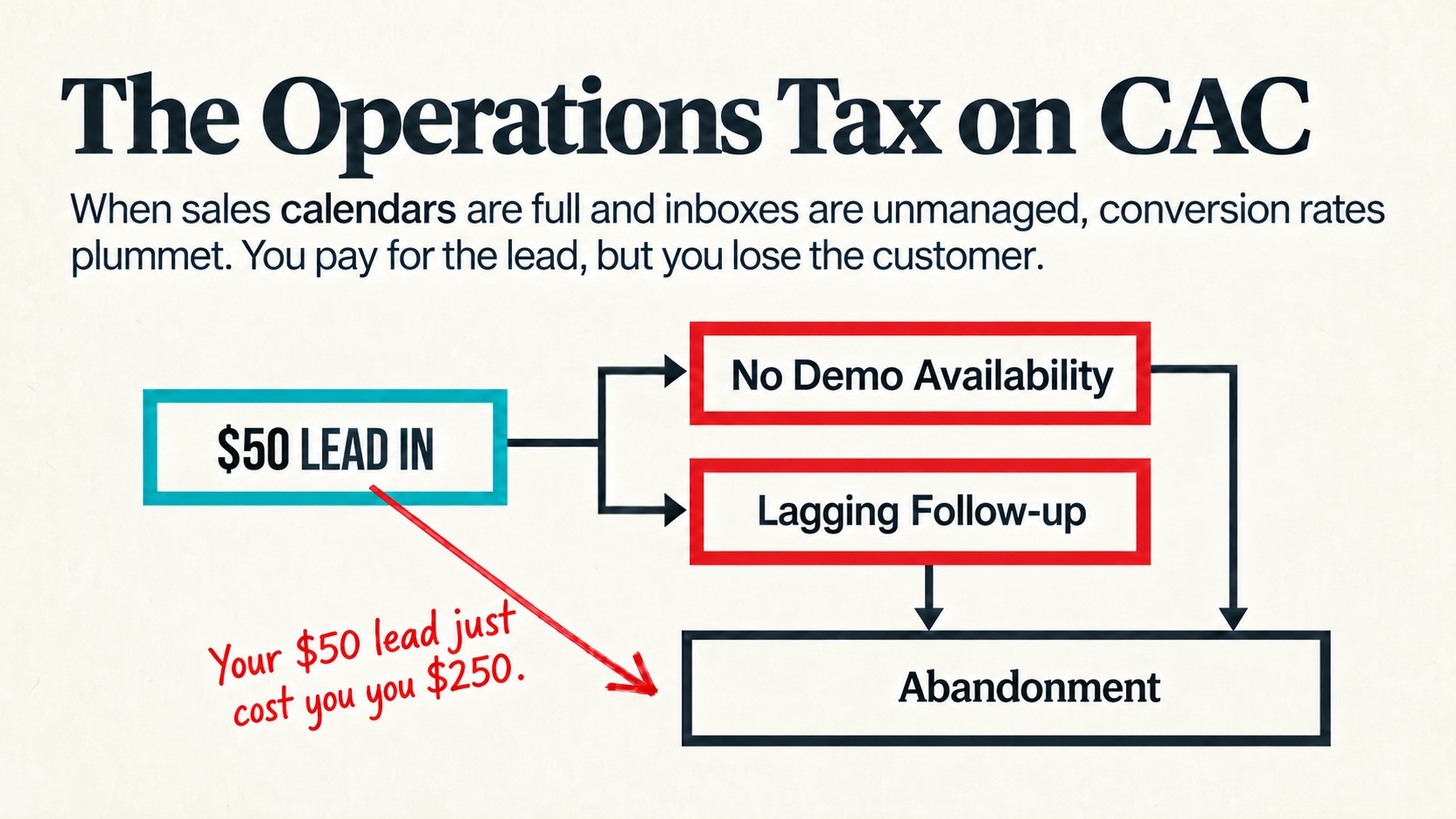

I realized this after running into client “marketing problems” that were not really marketing problems at all. They were infrastructural problems. They were built into the way the business already operated, and no amount of tweaking the campaign was going to fix them.
“Sometimes the next marketing optimization lives somewhere else in the business.” - Angelou Masters
Converting more leads might require changing how the company handles the leads it already has, especially if the existing pipeline was built for referrals or a completely different sales process. Better ad performance might depend on improving communication between designers, decision makers, and the people approving creative so the campaign can actually move at the speed it needs to be competitive. Closing more prospects might mean building basic email automations for the sales team, even if those automations technically sit outside the scope of the marketing retainer.
At a certain point, you can optimize the offer, the creative, the targeting, the landing page, and the budget, and still be staring at the same business result. That is usually the signal that the next improvement is not going to come from inside the campaign.
This is where marketing becomes a useful lens into the rest of the company. If the campaign is doing its job but the results are still getting lost somewhere between interest and revenue, the question changes from “How do we make the marketing better?” to “What inside the business is preventing this opportunity from becoming growth?”
That is the point where infrastructure stops feeling like a separate operational concern and starts becoming part of the marketing and growth conversation.
Build for the result. Not the resource
To most small business owners two companies we looked at earlier may seem like they had completely different problems. One struggled to turn a new employee into growth. The other struggled to turn new leads into customers. But by this point, we can see that they were dealing with different versions of the same problem: they added a resource without restructuring the business around the result that resource was supposed to create.
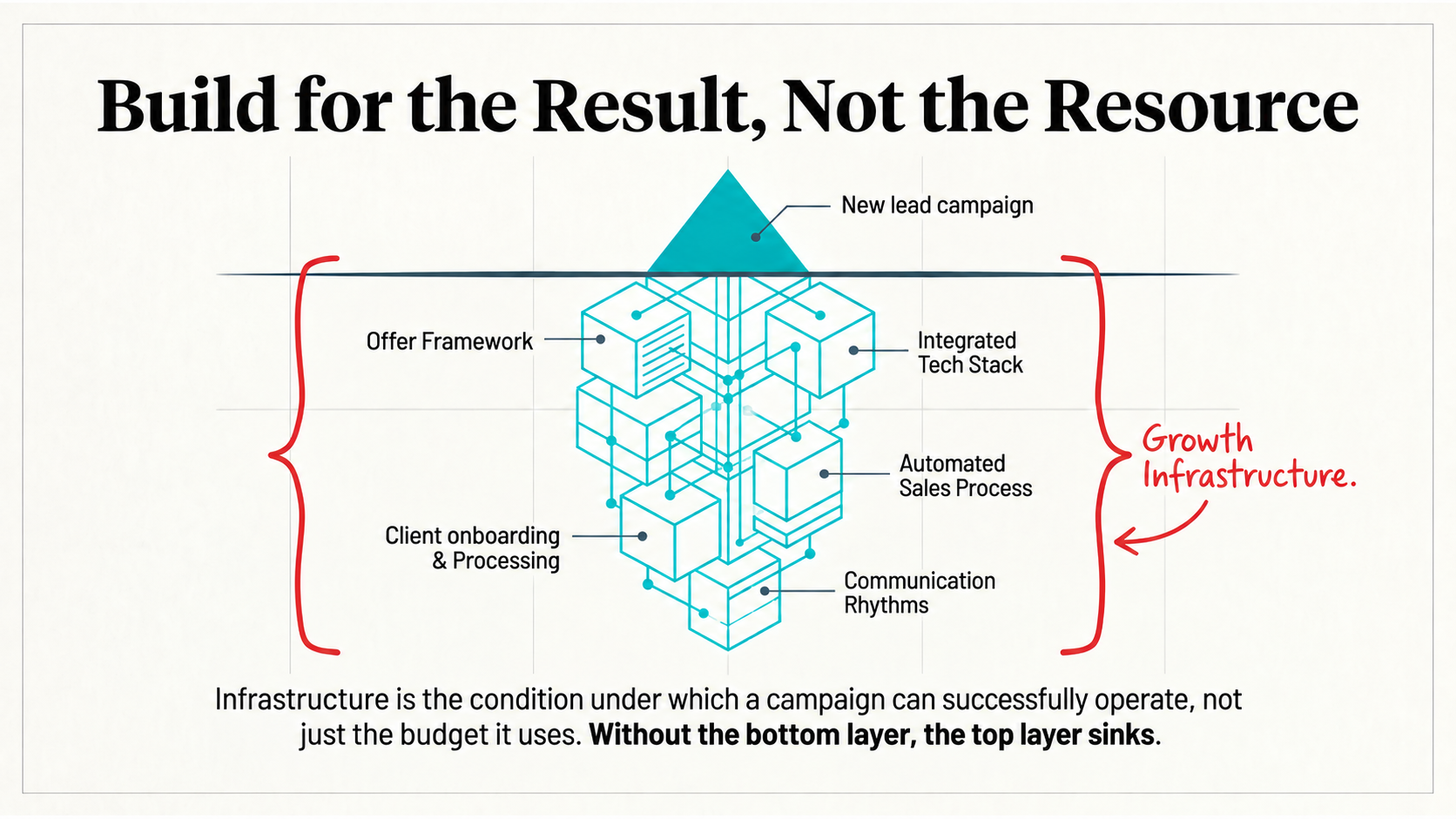
This is what I mean when I talk about Growth Infrastructure.
Growth Infrastructure is the structure that helps a business convert what it adds into the result it actually wants. It's what I’ve been talking about the whole time.
That structure can include
People
Technology
Processes
Communication
Decision making
Measurement
Changes to how existing work moves through the company.
Sometimes it requires adding something new. Just as often, it means restructuring what is already there so the business can support where it is trying to go next.
And no, this does not mean the founder now needs to know how to do everything themselves! If your sales process needs email automation, you do not need to become an automation engineer over the weekend. If a new employee needs clearer policies and responsibilities, you do not suddenly need an HR degree. The owner's responsibility is not to personally execute every piece of the infrastructure. It is to recognize what the desired result requires and make sure those conditions exist.
That might mean bringing in a specialist. It could mean changing someone's responsibilities, adopting a different piece of technology, giving an employee more decision making authority, reorganizing a pipeline, creating a better handoff between departments, or finally documenting the process everyone has been carrying around in their heads.
This is why I think founders have to build for the result, not the resource. If you hire a salesperson, do not only build a place for a salesperson to sit. Build the conditions that allow more sales to happen. If you generate more leads, do not only build a campaign that can produce them. Build the path that allows those leads to become customers. If you want more customers, make sure the business can serve more customers without sacrificing the experience that helped you earn them in the first place.
The goal is not to build a bigger business simply by collecting more things. It is to build a business that knows what to do with more when it arrives.
So before the next hire, campaign, tool, product, or big growth initiative, the better question may not be, “What do we need more of?”
It may be: “What result are we actually trying to create, and what has to be true inside the business for that result to happen?”
About the Author
It’s me, Angelou! I’m Angelou Masters, a marketing strategist, business owner, and self described Marketing Architect. I spend most of my time thinking about how marketing, technology, operations, and good old fashioned business sense work together to help small businesses grow without creating more chaos in the process.
I write about modern small business, growth infrastructure, marketing, AI, and the systems behind companies that actually work. Basically, if it helps founders build smarter, market better, or get out of their own way, I’m probably interested in it.